Small Safari Camp or Luxury Lodge: Which Gives You the Better Serengeti Experience?
September 27, 2026
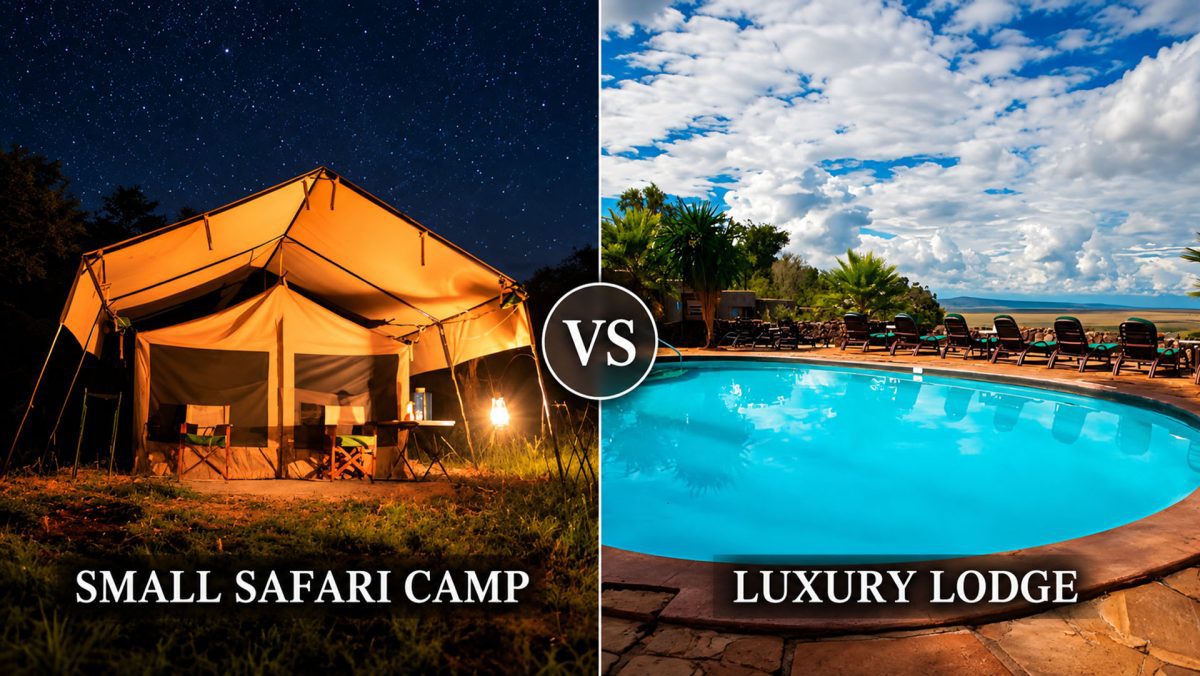
The choice between a small safari camp vs luxury lodge sounds simple until you begin comparing actual properties in the Serengeti. A canvas tent may contain a king-sized bed, an ensuite bathroom and a private plunge pool. A lodge may have only a handful of rooms and feel more secluded than a much larger tented camp.
The names can be misleading. What matters is how the accommodation changes your day: how close you are to the wildlife, what you hear at night, whether you can comfortably spend an afternoon at the property and how many other guests share the experience with you.
There is no universally better option. However, there is usually a better choice for a particular traveller and a particular section of the Serengeti.
Start with location, not the type of room
Before comparing canvas walls, swimming pools or wine lists, find the property on a map. Location can influence your safari more than almost any accommodation feature.
The Serengeti is enormous. Staying in the wrong area for the season can mean spending several additional hours driving towards the wildlife you came to see. A modest camp positioned near the Ndutu plains during calving season may offer a more rewarding safari than an exceptional lodge located far from the herds.
The same principle applies during the river-crossing months. A camp in the northern Serengeti can place you within practical reach of the Mara River, while accommodation in the central region may require too much driving for a realistic crossing attempt.
When choosing Serengeti safari accommodation, ask where it is located, which wildlife areas are accessible and how long the first drive of the morning is likely to take. The answer should be based on your travel dates rather than a property’s star rating.
What is a small safari camp?
A small safari camp generally has fewer tents or suites, often arranged around a shared dining tent, lounge and evening fire. Some are permanent, while others are seasonal or mobile camps that move between parts of the Serengeti as wildlife patterns change.
Small does not necessarily mean basic. The Serengeti has boutique camps with proper beds, flushing toilets, indoor and outdoor showers, solar electricity, attentive service and carefully prepared meals. Some even have swimming pools, private decks or separate family tents.
At the simpler end, a camp may provide bucket showers, limited charging hours and a smaller communal area. That can still be extremely comfortable, but it is important to know what you are booking.
The defining characteristic is usually intimacy rather than the material used to construct the room.
Why people fall in love with small camps
A small camp allows the Serengeti to remain present even after the game drive has ended.
Canvas does very little to mute the outside world. At night, you may hear zebras grazing, hyenas calling or lions roaring somewhere across the plains. Wind moves through the grass, insects take over the evening soundtrack and the first birds begin before sunrise. For many guests, these sounds become some of the clearest memories of the safari.
The atmosphere can also feel more personal. With perhaps eight or twelve tents, staff quickly learn how you take your coffee and whether you prefer to eat early before a morning drive. Dinner may be shared around one table, followed by stories beside the fire.
Fewer rooms can mean fewer people moving through the common areas. You are less likely to encounter a crowded reception, several tour groups arriving together or a breakfast room that feels disconnected from the landscape.
This is why smaller camps often appeal to couples, honeymooners, photographers and travellers who want the accommodation to feel like part of the safari rather than somewhere they simply sleep.
The trade-offs of a small camp
The qualities that make a small camp atmospheric can also make it unsuitable for some guests.
Canvas carries sound. You may hear animals, wind, neighbouring tents and camp staff beginning their morning preparations. Earplugs can help, but a very light sleeper may feel more rested behind solid walls.
Facilities are usually limited by design. There may be no spa, gym, shop or air conditioning. Wi-Fi might work only in the lounge, and electricity may be generated through solar systems with restrictions on high-powered appliances. Hairdryers are frequently unavailable.
Small camps can also be surprisingly social. A camp with one lounge and one shared dining table offers fewer places to disappear. Guests who value complete privacy should ask whether private dining is available and whether their tent has its own sitting area.
Most Serengeti camps are unfenced. After dark, guests are normally escorted between their tents and the communal area. This is part of the experience, but nervous travellers and families with young children should understand the routine before arrival.
What does a luxury safari lodge offer?
A luxury lodge usually has more permanent construction and a broader range of facilities. Rooms may include solid walls, large bathrooms, reliable power, expansive windows, private terraces and, at certain properties, air conditioning or plunge pools.
The main lodge may provide a swimming pool, spa, gym, library, shop, several dining spaces and a larger bar or terrace. These features are especially valuable if your itinerary includes shorter morning and afternoon drives with several hours at the lodge in between.
Families may appreciate interconnected rooms, children’s meals and space to move around outside the sleeping area. Travellers who want a predictable level of physical comfort may also prefer the more substantial design of a permanent lodge.
However, “luxury lodge” does not automatically mean a large hotel. Some properties combine permanent buildings with a small room count and highly personal service. Likewise, some tented establishments are large enough to operate much like resorts.
A practical comparison
| Consideration | Small safari camp | Luxury lodge |
|---|---|---|
| Atmosphere | Intimate and closely connected to the bush | More substantial, polished and resort-like |
| Night sounds | Clearly audible through canvas | Usually softened by solid walls |
| Facilities | Fewer, although some premium camps have pools and spas | More likely to include a pool, spa, gym and multiple lounges |
| Privacy | Few guests, but more communal dining and shared spaces | More guests, but larger rooms and more places to retreat |
| Power and connectivity | May have limited charging and Wi-Fi | Often more consistent, but never assume |
| Best for | Immersion, romance and a traditional safari atmosphere | Facilities, family comfort and leisurely afternoons |
How much time will you spend at the property?
This question often settles the debate.
If you plan to leave before breakfast with a picnic lunch and return near sunset, you may barely use a swimming pool, spa or extensive lounge. Location, sleep quality and the atmosphere at dinner become more important than a long list of amenities.
If you prefer a morning game drive, lunch at the property and another drive later in the afternoon, the accommodation becomes a larger part of your holiday. A pool and a comfortable shaded terrace can transform the hours between drives, especially during warmer months.
Our first-time Tanzania safari guide recommends giving the Serengeti enough time rather than rushing through it. Once you spend three or more nights in one region, the question of how you use the camp between drives becomes much more relevant.
Which is better for a honeymoon?
Small camps often win on atmosphere. Fewer guests, lantern-lit paths, dinner beneath the stars and the sound of the Serengeti outside your tent create a natural sense of occasion.
But intimacy is not guaranteed by room count. Some camps encourage shared dining every evening, while a lodge may offer a private terrace, room service, a plunge pool and more freedom to spend time alone.
Honeymooners should ask about private meals, the distance between rooms, outdoor space and whether the property hosts large groups. Those details reveal more than the word “boutique” in a brochure.
Which works better for families?
A permanent camp or lodge is often easier for families, particularly when children need flexible meals, a pool or space to relax between drives. Family suites and interconnected rooms can make evenings considerably simpler.
Nevertheless, an appropriately chosen small camp can be wonderful with older children. The smaller setting allows them to learn the names of staff members, watch tracks around camp and experience the sounds of the bush without the distraction of a large property.
Check the minimum age, room configuration, pool supervision, walking distances and whether the property accepts children on shared game drives. An unfenced lodge still follows wildlife safety procedures, so solid walls should not be confused with a conventional fenced resort.
What about older travellers and limited mobility?
Do not assume a lodge is automatically more accessible. A large property can involve long walks, slopes and numerous steps between the room, restaurant and vehicle area. A small camp may be compact enough for the vehicle to stop close to the tent.
Ask for exact information: the walking surface, number of steps, bathroom design, distance to communal areas and whether assistance is available at night. These practical details should determine the choice, not the accommodation category.
For photographers, position matters most
Photographers generally benefit more from the right location, a private vehicle and flexible departure times than from a particular style of accommodation.
A seasonal camp can be particularly valuable because it may position you near a temporary concentration of wildlife. During February in Tanzania, for example, accommodation around Ndutu and the southern plains can reduce the journey to calving areas.
Later in the year, a northern camp may make more sense for a trip following the herds. A route such as our Wonders of the Migration safari uses the itinerary itself to determine where each night should be spent.
A beautiful lodge in the wrong part of the ecosystem cannot recover the hours lost travelling to the day’s main wildlife area.
The strongest itinerary may include both
You do not have to choose one accommodation style for the entire journey.
A rewarding combination might include an intimate tented camp in the Serengeti, followed by a solid-walled property in the cooler highlands. Our guide to where to stay in Ngorongoro explains why location, altitude and crater access create a different accommodation decision there.
Alternating styles also gives the safari rhythm. A few nights close to the sounds and movement of the plains feel more distinctive when followed by a deep bath, substantial walls and an unhurried evening at a lodge.
This mixture can be incorporated into a route such as an eight-day Tarangire, Serengeti and Ngorongoro safari, rather than trying to make one property style satisfy every stage of the trip.
Questions to ask before booking
Accommodation descriptions tend to emphasise romance and scenery. Before paying a deposit, ask questions that reveal how the property actually operates:
- Where is the property located in relation to the wildlife area we expect to visit?
- Is the camp permanent, seasonal or mobile?
- How many rooms or tents does it have?
- Does every room have a private bathroom and flushing toilet?
- Is hot water continuously available or supplied at requested times?
- Can cameras and other equipment be charged inside the room?
- Does Wi-Fi reach the rooms or only the main lounge?
- Is there a pool, and is it open throughout the year?
- Are meals shared, individually seated or flexible?
- How far is the room from the dining area and vehicle pickup point?
- Are guests escorted after dark?
- What are the policies for children and travellers with limited mobility?
These answers are more useful than debating whether a property should technically be called a camp or a lodge.
So, which gives you the better Serengeti experience?
Choose a small safari camp if you want the accommodation to deepen your connection with the Serengeti. It is difficult to reproduce the feeling of lying beneath canvas while wildlife moves somewhere beyond the lantern light.
Choose a luxury lodge if substantial rooms, extensive facilities and comfortable afternoons are central to your holiday. The lodge may be the better option for families, light sleepers or anyone who wants safari days balanced with resort-style relaxation.
But make the location decision first. Then consider how you prefer to sleep, eat and spend the hours between game drives. A thoughtfully positioned camp with the right level of comfort will outperform an impressive lodge in the wrong place, and the reverse is equally true.
If you are still divided, browse our Tanzania safari itineraries and look at the journey as a whole. You may discover that the best answer is not camp or lodge. It is knowing where each one belongs.
We can also help you compare specific properties against your dates, route and preferred pace. Tell us how you want the safari to feel, and we will suggest accommodation for the experience rather than selecting it by label alone.