Will a Safari Camp Have Wi-Fi, Hot Water, Fans and Charging?
November 2, 2026
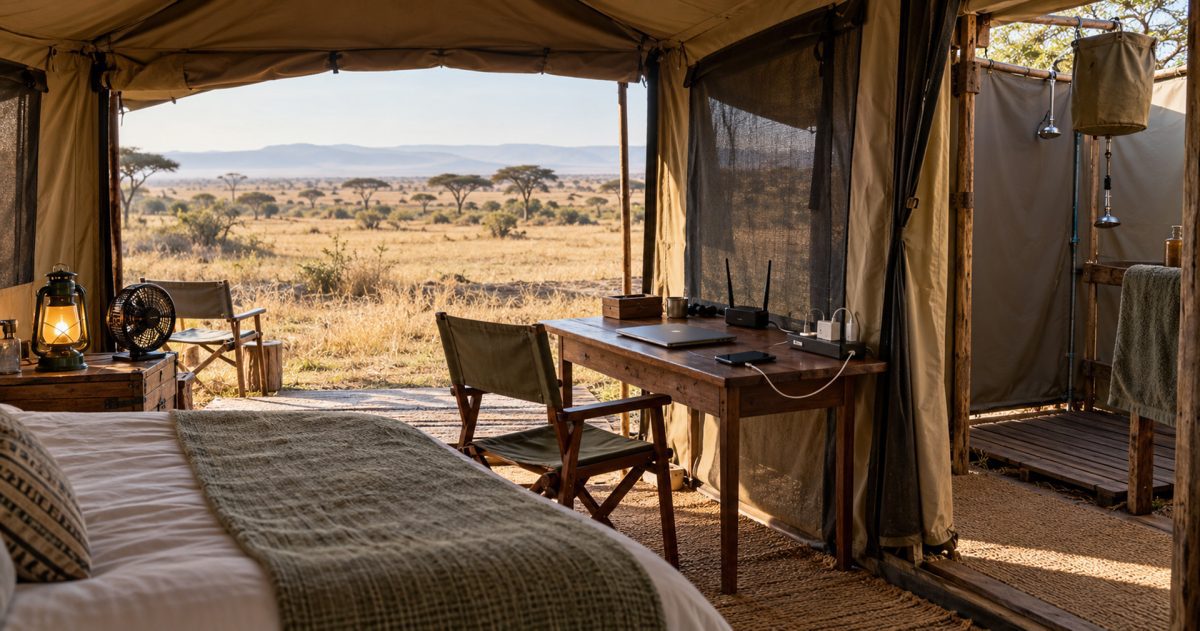
Mostly yes, but not always in the way you expect. Most safari camps in Tanzania can charge your phone and camera, and almost all have hot water. Many have Wi-Fi, though it is often slow and only works in the main lounge area. Fans are less common, and air conditioning is rare in tented camps. Hair dryers usually will not work at all.
The details depend on the type of place. A permanent lodge with solid walls often feels close to a hotel. A small tented camp running on solar power feels very different, and a mobile camp that moves with the migration is simpler still. Knowing which you are booking makes a big difference to packing and to expectations. If you are still in the early stages of your Tanzania safari planning, this guide to safari camp amenities in Tanzania will save you a few surprises.
The Quick, Honest Version
- Charging: Yes at almost every camp. Sometimes in your tent, often only in the main area.
- Hot water: Yes. It might come from a solar heater, a wood-fired boiler or a bucket filled by staff.
- Wi-Fi: Usually, but expect it to be slow and often limited to the lounge.
- Phone signal: Patchy. Better near gates, lodges and some camps. Gone on many game drive tracks.
- Fans: Sometimes. Battery or solar fans are more common than ceiling fans.
- Air conditioning: Rare in camps. More likely at large permanent lodges.
- Hair dryers and straighteners: Usually not possible on camp power.
Now for the detail behind each of these.
Where the Power Comes From
Most safari camps are a long way from any power line. They make their own electricity, usually with solar panels and banks of batteries, backed up by a generator for cloudy spells. Some camps run the generator only for a few hours a day, often while guests are out on game drives. Others switch it off completely at night to keep the bush quiet.
This is why camp power is limited. Solar systems are designed for lights, phone and camera charging, the kitchen and water pumps. They are not designed for high-wattage appliances that pull a lot of power at once. Plug in a hair dryer and you may trip the whole system.
Large lodges are different. Many have bigger generators or more powerful systems, so they can offer things like hair dryers, air conditioning and a pool pump running all day. If reliable power matters to you, a lodge is the safer choice.
Charging at a Safari Camp: What Actually Happens
Charging at a safari camp is easy once you know the routine. Many camps now have charging points in every tent, often USB sockets as well as standard plugs. Simpler camps keep charging in the main area, sometimes in a shared charging station where you leave your batteries and pick them up later. Staff are used to this and look after your gear carefully.
A few habits make life easier:
- Bring a universal adapter. Tanzania uses Type D and Type G sockets, at 230 volts and 50 hertz. Camps often have a few spare adapters, but not always enough.
- Check your chargers. An adapter only changes the shape of the plug. If any device only works at 110 to 120 volts, you need a converter, not just an adapter. Most phone and camera chargers handle both.
- Pack a power bank. It keeps your phone alive on long game drives and covers you if your tent has no socket.
- Charge during the day. If a camp limits power at night, plug in as soon as you get back from your morning drive.
- Bring spare camera batteries. A day of photographing a migration herd can drain two or three.
Many safari vehicles also have charging points, so you can top up between sightings. It is worth asking your operator what is fitted in the vehicle you will use.
Wi-Fi in Serengeti Camps, and Phone Signal
Wi-Fi in Serengeti camps has improved a lot, and many now offer it. But set your expectations low. Connections often rely on a mobile signal or a satellite link, both of which can be slow or drop out. Many camps offer Wi-Fi only in the main lounge or dining area, not in the tents. Some deliberately keep it that way so the bush stays peaceful.
It is fine for messages, email and sending a few photos home. It is rarely good enough for video calls or uploading large files. If you need to work while you travel, ask about the connection at each camp before you book.
Mobile signal is similar. Tanzania’s main networks, including Vodacom, Airtel, Yas, Halotel and TTCL, have coverage near park gates, lodges and many established camps in areas such as the Serengeti, the Ngorongoro Conservation Area, Tarangire and Lake Manyara. But coverage is not continuous, and you will lose signal for long stretches on game drives.
Two ways to stay connected:
- An eSIM. Set it up before you leave home, and you have data the moment you land. Most tourist eSIMs are data only, with no local phone number.
- A local SIM card. You will need your passport, and registration at an official shop can include a fingerprint scan and a photo, so allow some time in Arusha.
Before you head into the parks, download offline maps, copies of your bookings and your emergency contacts. Camps and guides carry radios or satellite phones for emergencies, so you are never truly cut off, even when your phone is.
Hot Water: Lodge Plumbing or Bucket Shower?
Hot water is almost guaranteed, but how it reaches you varies.
Plumbed hot water is what you get at almost any safari lodge, and at most permanent tented camps. It is heated by solar panels, gas or a wood-fired boiler that staff keep burning outside. It works like a normal shower, though water pressure can be gentle. Solar-heated water is hottest in the afternoon, so an evening shower is often better than a dawn one.
Bucket showers are common in mobile and more rustic camps. Staff fill a canvas bag or bucket with around 10 to 15 litres of hot water and raise it above your shower. You turn a valve to let it flow. It sounds basic, but it works well. Water in many safari areas is scarce, so this is enough for a good wash if you turn it off while soaping. Tell staff when you want your shower, use it straight away while the water is hot, and do not be shy about asking for a refill.
A good rule: if a camp description mentions “bucket shower” or “safari shower”, expect this system. If you are not sure, ask.
Fans, Heat and the Cold Nobody Warns You About
Heat is less of a problem than many people expect. Much of northern Tanzania sits at altitude, so nights are cool in many places. Tents are designed for airflow, with large mesh windows that let the breeze through. Some camps provide a battery or solar fan. Air conditioning is rare in tented camps, though some lodges have it.
Lower, hotter areas such as Tarangire and parts of the northern Serengeti can be warm in the afternoon, especially before the short rains. The midday break in camp is when you will most want a fan or a pool.
Cold is the real surprise. Lodges on the Ngorongoro Crater rim sit well above 2,000 metres, and nights there are properly cold. Temperatures can drop to around 6°C even in the wet season, and on the coldest nights from June to September it can approach freezing. Pack a warm fleece and a hat. Many camps and lodges add hot water bottles to the bed at night, and a few have fireplaces in the rooms or main areas.
>Things That Will Not Work in Most Tents
- Hair dryers, straighteners and curling tongs. These need too much power for most solar systems. Some lodges have them, but plan to manage without. A good hat helps.
- Electric kettles and travel irons. Same problem. Camps provide tea and coffee, and staff can usually help with creases.
- Drones. Not an amenity issue, but worth knowing. Flying a drone in a national park needs approvals from the Tanzania Civil Aviation Authority and the relevant park authority. Do not bring one hoping to fly it on a whim.
>Medical Devices Need a Quiet Word in Advance
If you use a CPAP machine, need to keep insulin cold or rely on any powered medical device, tell your operator when you book. Most camps can help, but they need to plan. That might mean placing you in a tent with a power socket, providing a battery or inverter overnight, or keeping medication in the kitchen fridge. Do not leave this until you arrive.
It is also worth bringing your own backup, such as a portable battery for a CPAP machine, in case of an unexpected power cut.
>A Short Packing List for Power and Comfort
- Universal adapter that covers Type D and Type G
- Power bank and spare camera batteries
- Headtorch for the tent at night
- Warm layer and hat for cold mornings and the Ngorongoro rim
- Offline maps and downloaded documents
- Patience with Wi-Fi
>The Upside of Being a Little Disconnected
It is worth saying plainly: limited power and slow Wi-Fi are part of what makes a safari camp feel the way it does. The generator is off, the bush is quiet, and nobody at the dinner table is scrolling. Many travellers arrive worried about staying connected and leave wishing they had switched off sooner.
If you do need reliable power or internet, for work, for medical reasons or simply for peace of mind, that is easy to plan around. Mixing a few nights at a well-equipped lodge with a stay in a more rustic camp in the Serengeti gives you the best of both. Roy Safaris can tell you what each camp on your route really offers, or you can personalise your safari around the comforts that matter to you.
Amenities are only part of the decision. See what makes a small luxury safari camp worth it, our picks for honeymoon safari accommodation, and the wider guide to luxury safari accommodation in Tanzania.