The Safari Quote Checklist: What Should You Compare Before Looking at the Price?
September 28, 2026
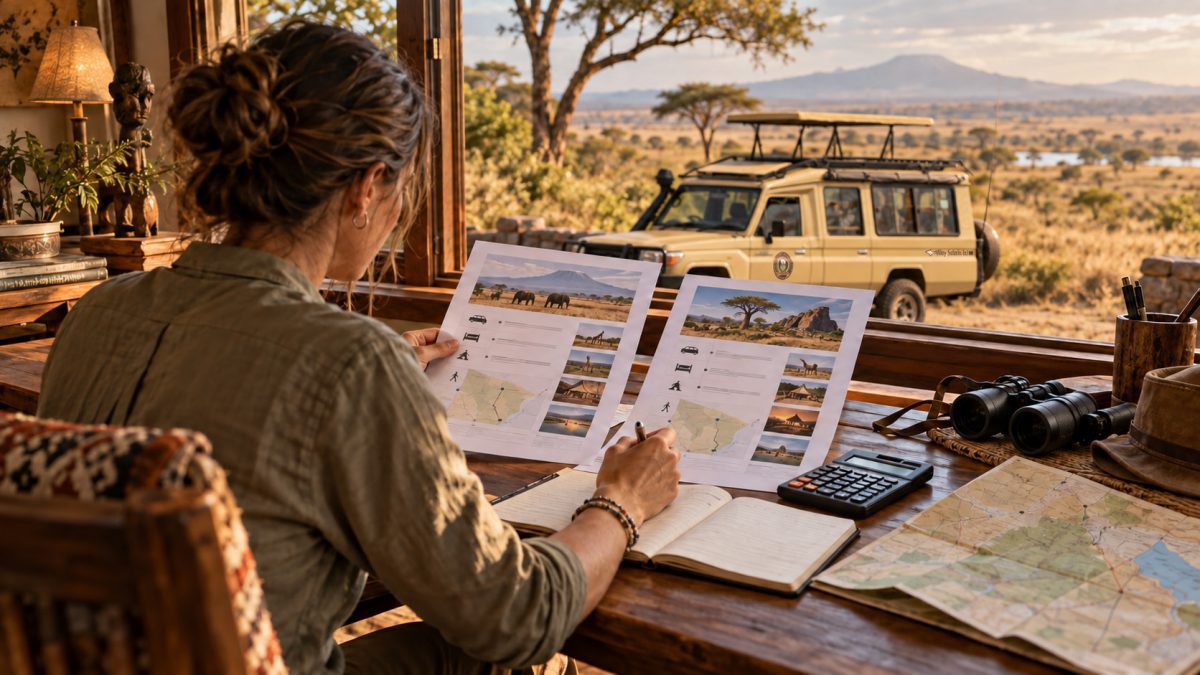
Two safari proposals can follow the same route, use similar-looking lodges and still differ by thousands of dollars. The cheaper one may be excellent value. It may also be missing park fees, using a shared vehicle, placing you outside the wildlife area or quoting a different room category.
Learning how to compare safari quotes means looking beyond the total at the bottom of the page. You need to establish whether the operators are pricing the same journey in the first place.
A Tanzania safari quote is not simply a hotel reservation with transport added. It combines a vehicle, driver-guide, accommodation, meals, conservation charges, transfers and sometimes domestic flights. A small change to any one of these elements can alter both the price and the experience.
Before deciding that one Tanzania Safari Company is more expensive than another, place the proposals next to each other and work through the following checklist.
First, make sure the itineraries are genuinely identical
Many quote comparisons begin with a mistaken assumption: both operators have mentioned the Serengeti, Ngorongoro and Tarangire, so they must be selling the same safari.
Look at the journey day by day. One proposal may provide three complete game-drive days in the Serengeti. Another may describe three Serengeti days, but one is largely spent driving into the park and another driving out.
Check the following:
- How many nights are included?
- How many full game-drive days are included?
- Which Serengeti region will you visit?
- Where will each overnight stay be located?
- Are arrival and departure days treated as safari days?
- How much time will be spent driving between destinations?
- Does the route require backtracking?
A well-paced seven-day safari can deliver more useful wildlife time than a rushed nine-day itinerary containing too many destinations. Our first-time Tanzania safari guide explains why repeatedly changing accommodation can consume some of the best hours of the day.
Use this safari quote comparison table
| Compare | What the quote should clarify | Why it matters |
|---|---|---|
| Vehicle | Private or shared, vehicle type and number of passengers | Controls comfort, flexibility and time at sightings |
| Guide | Private driver-guide, language and continuity throughout the trip | Guiding quality shapes almost every safari day |
| Park charges | Entry, concession, transit, vehicle and crater fees | Missing charges can create substantial later payments |
| Accommodation | Exact property, room category, board basis and location | Similar property descriptions can conceal major differences |
| Flights | Fare, taxes, luggage limits and airport transfers | A flight may be mentioned in the route but excluded from the price |
| Meals and drinks | Breakfast, lunch, dinner, water and other beverages | Meal plans differ between hotels, lodges and camps |
| Terms | Deposit, balance date, cancellation schedule and refund conditions | The cheapest price may carry the least flexible terms |
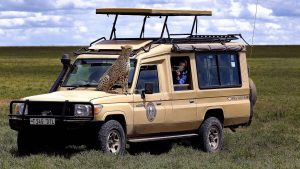
Is the safari vehicle private or shared?
This is one of the first questions to ask because the answer changes both the price and the way the safari operates.
On a private safari, the vehicle and driver-guide are allocated to your party. You decide when to leave, when to return and how long to remain at a sighting. If you want to spend an hour watching a leopard or return early because the children are tired, you can.
On a shared safari, the cost is divided among several travellers. It can be a sensible way to reduce the price, but the daily schedule becomes a group decision. Travellers may join or leave at different points, and the vehicle may have to accommodate competing interests.
Do not accept the phrase “4×4 safari vehicle” as a complete answer. Ask:
- Is the vehicle exclusive to our party?
- How many passengers will it carry?
- Does every traveller have a window seat?
- Does it have a photographic roof?
- Will the same vehicle remain with us throughout the safari?
- Is unlimited game-drive mileage included?
- Are fuel and vehicle park-entry charges included?
A private safari vehicle costs roughly the same to operate whether it carries two people or five. This is why the per-person price normally falls when more friends or relatives share the same private trip.
Who will actually guide the safari?
A lodge, vehicle and itinerary can be photographed. The judgement of a driver-guide cannot, yet it may be the most important part of the entire quote.
Find out whether the operator employs its own guides, assigns one guide for the complete journey or contracts different people for separate sections. Changing guides is not always a problem, particularly on fly-in safaris, but it should be clear before booking.
A full-time guide travelling with you learns your interests. By the third day, that guide knows whether you are fascinated by birds, impatient with crowded sightings or willing to wait quietly for a predator to move.
Also confirm the guiding language. “English-speaking guide” can describe a wide range of communication ability. If detailed wildlife interpretation is important, ask about experience, training and how long the proposed guide has worked in the relevant parks.
Check every park fee, not just “all fees included”
Conservation charges form a significant part of a Tanzania safari price. They may include park entry fees, vehicle fees, concession fees for sleeping inside protected areas, transit charges and the separate fee for descending into Ngorongoro Crater.
The exact combination depends on the itinerary. A night inside the Serengeti is not charged in precisely the same way as a night outside the park. Passing through Ngorongoro Conservation Area on the way to the Serengeti may also create charges even when a crater game drive is not planned.
Ask the operator to confirm in writing whether the quoted amount includes:
- National park entry fees
- Ngorongoro Conservation Area charges
- Ngorongoro Crater descent fee
- Concession or camping fees
- Vehicle entry fees
- Transit fees
- Applicable taxes
If a proposal says that government fees are subject to change, ask what happens if they increase after your deposit. Will only the difference be charged, or is the complete safari price still adjustable?
One quote can look substantially cheaper simply because these charges will be invoiced later.
Compare the exact accommodation, not the word “luxury”
Terms such as budget, comfort, mid-range and luxury are not standardised. One operator’s luxury camp may be another operator’s upper mid-range property.
Ask for the name of every lodge or camp, not merely “a luxury lodge in Serengeti.” Once you have the name, confirm:
- The exact room or tent category
- Whether it is a double, twin, triple or family room
- Whether the bathroom is private
- Whether the quoted rate is for single or double occupancy
- Whether the property is inside or outside the protected area
- Whether the booking is confirmed or subject to availability
- Which alternative property will be used if it is unavailable
A camp inside the Serengeti may cost more because of its location and applicable concession charges. A cheaper lodge outside the park can still be excellent, but it may add time at the gate every morning and evening.
This becomes especially important when comparing a seasonal Serengeti safari. A camp near Ndutu during the calving period and a camp near the Mara River during the crossing season are not interchangeable simply because both carry a Serengeti address.
Does the quotation guarantee the named properties?
Look for phrases such as “or similar,” “subject to availability” and “accommodation to be confirmed.” These are normal when a trip is quoted before rooms are held, but you should understand what they permit the operator to change.
Ask whether accommodation has been provisionally held and how long that hold will remain valid. If a substitute becomes necessary, it should be comparable in location and standard, not merely in price.
The substitution question is particularly important in peak season. A replacement property an hour farther away can change the daily route even when its rooms are equally luxurious.
Check the meal plan and drinks
Most lodge-based safaris include breakfast, lunch and dinner, but arrival and departure days sometimes create gaps. A late arrival may occur after the lodge’s dinner service. A domestic flight may land after breakfast but before the first included lunch.
Confirm whether the quote includes:
- Breakfast, lunch and dinner on every day
- Picnic lunches during full-day game drives
- Drinking water in the safari vehicle
- Soft drinks, local beverages or premium drinks
- Special dietary arrangements
- Meals in Arusha, Dar es Salaam or Zanzibar
“Full board” normally refers to meals, not necessarily every drink. “All-inclusive” can also mean different things at different properties.
Domestic flights need their own checklist
A route may show a flight from the Serengeti to Zanzibar without clearly stating whether the airfare is included. The quotation should identify the route, approximate schedule, fare and taxes.
Check the luggage allowance carefully. Safari aircraft often use smaller planes with stricter weight limits and may require soft-sided bags. Excess luggage arrangements, storage and transfers between the lodge and airstrip should be settled before departure.
If a flight connects to an international departure, ask what contingency has been allowed for weather or operational delays. An itinerary that relies on a tight same-day connection may be cheaper but unnecessarily fragile.
For combined trips, compare how the safari company handles the handover between the bush and the coast. Our Tanzania safari and Zanzibar itineraries treat the domestic flight and transfers as part of one continuous journey rather than unrelated bookings.
Look for transfers hiding outside the safari
Airport transfers are easily overlooked because they happen before and after the exciting part of the itinerary.
Confirm collection and drop-off arrangements for every flight. Kilimanjaro International Airport, Arusha Airport and an Arusha hotel are different locations. In Zanzibar, the airport, Stone Town and the beach resorts can be separated by a substantial road transfer.
Ask whether the quote includes:
- International airport collection
- Transfers between Arusha and Kilimanjaro International Airport
- Transfers to and from domestic airstrips
- Zanzibar airport or ferry transfers
- Any required overnight stay before or after the safari
A proposal that starts with “Day 1: Depart Arusha” may assume that you have arranged your own hotel and transport to the departure point.
Activities may be listed but not included
An itinerary may mention a balloon safari, Maasai village visit, guided walk, night drive or cultural activity as an available experience. That does not always mean it is included in the price.
Optional activities should be clearly marked with their cost, payment deadline and cancellation terms. For example, a balloon safari in Tanzania usually requires advance booking and may have different refund conditions from the main land itinerary.
Ask whether transport to the activity is included and whether choosing it replaces a scheduled game drive.
Read the exclusions as carefully as the inclusions
The exclusions section often tells you more about the final cost than the headline price.
Common exclusions can include international flights, visas, insurance, vaccinations, gratuities, premium drinks, laundry, optional activities, personal purchases and changes caused by airline disruptions.
Tipping is normally separate from the safari price. It is better to budget for it in advance rather than discovering the expected amounts on the final day. Our Tanzania safari tipping guide breaks down the usual recipients and how tipping works on private and shared trips.
Compare deposits, cancellation terms and financial risk
A low price is less attractive if the full balance is required unusually early or every payment becomes non-refundable immediately.
Before paying, identify:
- The deposit percentage
- The final balance deadline
- The cancellation charges at each stage
- Whether domestic flights have separate conditions
- Whether lodge deposits are refundable
- What happens if you postpone rather than cancel
- Which costs remain payable after a government fee increase
- What happens if the operator must change the itinerary
Travel insurance should match those conditions. If a large portion becomes non-refundable six months before departure, the policy should already be active by then.
Put every operator into the same comparison format
Do not attempt to compare three beautifully designed proposals by repeatedly scrolling through them. Create one simple document with a column for each operator and rows for the points below:
- Total price and currency
- Number of travellers used for pricing
- Private or shared vehicle
- Number of full safari days
- Named accommodation and room categories
- Meals and drinking water
- Park, concession and crater fees
- Domestic flights and taxes
- Airport and airstrip transfers
- Optional activities
- Deposit and payment schedule
- Cancellation terms
Highlight every blank space. Those blanks become your questions to the operator.
The practical verdict: compare value before price
The lowest quote is not automatically suspicious, and the highest quote is not automatically better. A local operator may have competitive lodge rates, its own vehicles and fewer intermediary costs. Another operator may charge more because it has selected better-positioned accommodation or included a private vehicle that the cheaper proposal shares among six guests.
The correct question is not, “Why is this safari more expensive?” It is, “What am I receiving for the difference?”
Begin with the route and usable game-drive time. Then compare the vehicle, guide, accommodation location, park charges, flights, transfers and booking conditions. Only after those items match should you compare the totals.
You can browse our Tanzania safari itineraries to see how different routes, travel durations and regions fit together. Each itinerary can be adjusted, so the published journey should be treated as a starting point rather than a rigid package.
If you already have a route in mind, use our safari personalisation form to describe your dates, group size, preferred accommodation and budget. The resulting quote will be far easier to assess because it will be based on the trip you actually want, not a vaguely similar package.