How Big is the Serengeti? Size, Facts & Map
August 26, 2026
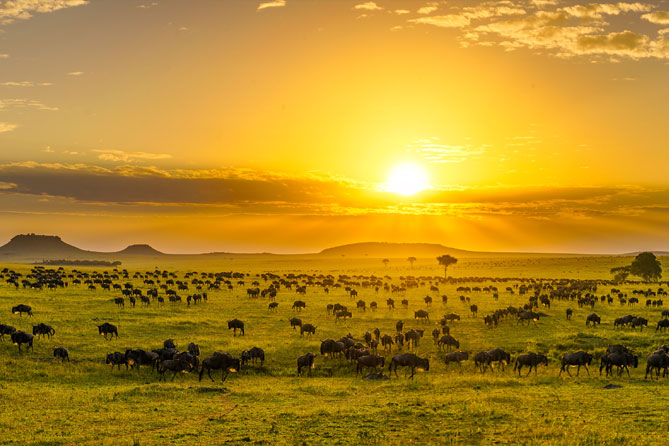
Serengeti National Park covers roughly 14,750 square kilometres (5,700 square miles) in northern Tanzania. That makes it about the size of Northern Ireland, or a little larger than the US state of Connecticut.
Add Roy Safaris as a Preferred Source for Safari News, Offers and African Travel
Let’s continue with the story. The wider Serengeti ecosystem, the full area the wildlife actually moves across during the Great Migration, is far bigger: around 30,000 square kilometres (12,000 square miles), stretching from northern Tanzania into Kenya’s Masai Mara. When people picture the endless plains (as featured in most magazines, blogs in Europe and America) and the migrating herds, they’re really picturing this larger ecosystem, not just the national park boundary.
- Serengeti National Park: ~14,750 km² (5,700 sq mi)
- Greater Serengeti ecosystem: ~30,000 km² (12,000 sq mi)
- Roughly: the size of Northern Ireland, or slightly larger than Connecticut
- Length: the park stretches about 160 km (100 mi) north to south
- Established: 1951; a UNESCO World Heritage Site since 1981
To put 14,750 km² in perspective:
- It’s about half the size of Belgium or roughly the size of Connecticut.
- It’s larger than the Masai Mara in Kenya (about 1,510 km²), which is essentially the northern continuation of the same ecosystem.
- Within Tanzania, it’s smaller than Nyerere National Park (formerly Selous, ~30,000 km²) and Ruaha (~20,000 km²), the country’s two largest parks, but the Serengeti is by far the most famous because of the Great Migration and its extraordinary density of predators.
Distances inside the park are longer than most first-time visitors expect. Driving from the southern plains up to the northern Kogatende area, where the Mara River crossings happen, can take the best part of a day on game-viewing roads. This is why many safaris cover the Serengeti in stages, moving between camps in different regions, or use light aircraft to hop between the airstrips that serve the south, central Seronera, western corridor and north.
The park is usually divided into four main regions, and each has its own character. The southern Serengeti and neighbouring Ndutu are open short-grass plains, best known for the calving season. The central Serengeti, or Seronera, has year-round resident wildlife and the highest concentration of big cats. The western corridor follows the Grumeti River toward Lake Victoria. The northern Serengeti, bordering the Masai Mara, is where the dramatic river crossings take place.
The Serengeti’s scale is the whole point of visiting, but it also shapes how you plan. Because the park is so large, the wildlife, and especially the migrating herds, is in a different part of it depending on the month. The calving season concentrates animals in the southern plains and Ndutu around January to March, while the famous river crossings happen in the north around July to October. No single lodge location is “best” year-round; the right base depends entirely on when you travel and where the herds are.
This is why a well-planned Serengeti safari is built around timing and location rather than just “seeing the Serengeti.” A route that follows the migration, or that positions you in the right region for your travel dates, makes the difference between endless game-viewing and long empty drives.
- Meaning of the name: “Serengeti” comes from the Maasai word siringet, meaning “endless plains.”
- Wildlife: home to the Big Five and the highest concentration of large predators in Africa.
- The Great Migration: around 1.3 million wildebeest, plus hundreds of thousands of zebra and gazelle, move through the ecosystem each year.
- Landscape: open grassland plains in the south, wooded savanna and granite kopjes in the centre, and riverine forest in the north.
A few other things people often ask about the Serengeti’s size and setting: it does not snow in the Serengeti, as the park sits close to the equator at a relatively low, warm altitude of around 920 to 1,850 metres. Its altitude keeps daytime game drives comfortable and nights cool. And while the plains can look empty in photos, that openness is exactly what makes wildlife so easy to spot across such a vast area, one of the reasons the Serengeti is so often rated the best safari park in Africa.
Want to see the Serengeti at its best? The region you stay in should match the month you travel. Explore our Serengeti safari itineraries or get in touch to plan a route timed around the migration.