Is Your Safari Packing List Too Long?
October 6, 2026
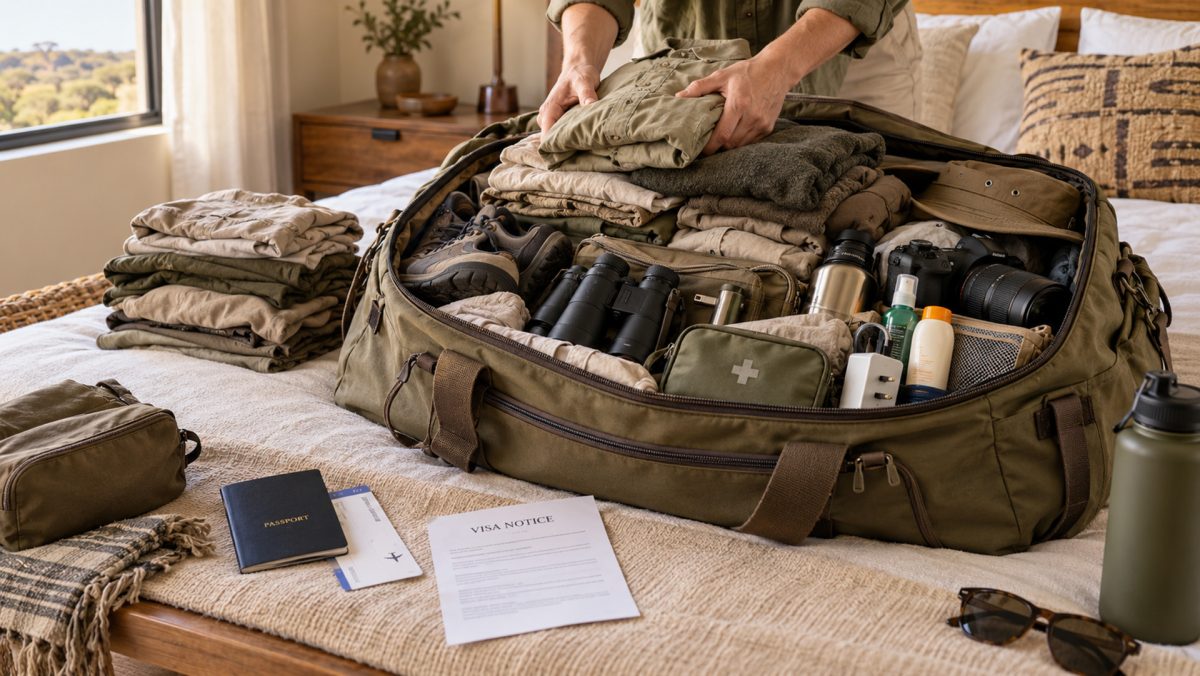
If your safari packing list includes a different outfit for every day, three pairs of boots and enough equipment to open a small outdoor shop, it is probably too long.
The most useful answer to what not to pack for safari is not a list of forbidden objects. It is an explanation of what repeatedly returns home unworn, why travellers use fewer clothes than expected and how one laundry stop can remove several kilograms from a bag.
Safari is surprisingly repetitive in the best possible way. You get dressed before sunrise, spend much of the day inside a vehicle, return covered in a fine layer of dust, shower and wear something simple to dinner. Nobody is keeping track of whether the same olive shirt appeared on Monday and Thursday.
The suitcase problem usually starts before the clothes
Before deciding how many trousers to take, look at the transport included in your itinerary.
International airlines may allow a large checked suitcase, but small aircraft flying to safari airstrips can impose considerably lower weight and size limits. Allowances differ between airlines and routes. Coastal Aviation currently states a 15-kilogram allowance per passenger, including hand luggage, while Auric Air publishes a 20-kilogram total allowance. Both recommend soft-sided bags because they fit more easily into light-aircraft baggage compartments.
The correct limit for your journey is the one attached to your actual ticket. If an itinerary contains several flights, pack to the most restrictive allowance rather than the most generous one.
A soft duffel is useful even on an all-driving safari. It is easier to fit into the luggage area of a Land Cruiser and simpler to carry between camps. A rigid suitcase may work on some routes, but it occupies a fixed amount of space even when half empty.
Check the transport details when planning a Tanzania safari, particularly if the route includes the Serengeti, Nyerere, Ruaha or Zanzibar by air.
Pack for four or five days, not the entire trip
A ten-day safari does not require ten complete daytime outfits.
For most conventional game-drive itineraries, four or five days of interchangeable clothing is enough. Shirts and trousers can be repeated, with laundry scheduled at a camp where you stay for at least two nights.
A practical clothing rotation might contain:
- Three or four lightweight shirts
- Two long-sleeved shirts
- Two or three pairs of safari trousers
- One comfortable evening outfit
- One fleece or warm mid-layer
- One light rain jacket where seasonally appropriate
- Enough underwear and socks for the planned laundry interval
These are not strict numbers. Someone who feels the cold may need an additional layer, while a traveller combining safari with Zanzibar will need a few lighter beach items. The principle is to create a small group of clothes that work together rather than ten unrelated outfits.
The items most likely to come home unused
| Frequently overpacked item | Why it goes unused | What to take instead |
|---|---|---|
| A fresh safari outfit for every day | Clothes are reworn and laundry is widely available | Four or five mix-and-match outfits |
| Several heavy jackets | Only the coldest morning hours usually require them | One fleece plus a packable outer layer |
| Technical hiking boots for vehicle safaris | Most of the day is spent inside the vehicle | Comfortable closed walking shoes |
| Formal dinner clothes | Safari camps are generally relaxed | One clean casual evening outfit |
| Full-size toiletries | They add weight and many camps provide basic products | Travel-size essentials in a small wash bag |
| Too many camera lenses | Dust and moving wildlife make constant lens changes inconvenient | One versatile zoom and one backup option if needed |
| Several guidebooks | They are heavy and rarely opened during game drives | One compact wildlife guide or offline digital references |
You probably do not need a safari costume
Safari clothing needs to be comfortable, practical and suitable for the weather. It does not need to make you look like a film explorer.
Specialist shirts with twelve pockets can be useful, but ordinary neutral clothing often works just as well. Comfortable cotton or quick-drying trousers, muted shirts and a warm layer are sufficient for most vehicle-based itineraries.
Avoid building an entirely new wardrobe around one trip. Start with clothes you already own in beige, khaki, olive, brown or muted grey, then fill the genuine gaps.
Bright colours are not automatically disastrous, but subdued clothing is less conspicuous during walks and often more practical around dust. In areas where tsetse occur, there are additional reasons to avoid using vivid blue or black as the main outer layer. Our guide explaining whether blue and black clothes attract tsetse flies separates the evidence from the exaggerated warnings.
Leave most of the shoes at home
Shoes consume an unreasonable amount of luggage space.
For a conventional game-drive safari, one comfortable pair of closed shoes and one pair of sandals or light shoes for camp will suit most travellers. The closed shoes should handle dusty paths, airstrips, lodge grounds and short walks without causing blisters.
Large hiking boots are justified when the itinerary includes serious walking, mountain trekking or difficult wet ground. They are unnecessary for someone whose most strenuous daily activity is climbing into a safari vehicle.
Formal shoes are also rarely needed. Safari lodges may be beautiful, but evening dress is usually relaxed. Clean casual clothing and comfortable footwear are enough for dinner.
If Zanzibar follows the safari, add one suitable pair of beach sandals rather than an entirely separate collection of holiday shoes.
Laundry changes the calculation
Many safari lodges and camps offer laundry, often returning clothes later that day or the following day. Availability, price and turnaround vary, so it works best at a property where you are staying for two nights.
Plan the wardrobe to reach that stay, have the main items washed and begin the rotation again. A ten-night journey may need only five days of clothing if laundry falls near the middle.
There are a few practical details to check:
- Laundry may be charged per item or included in the stay.
- Some camps do not wash underwear for cultural or privacy reasons.
- Delicate fabrics may not suit handwashing or outdoor drying.
- Cold or wet weather can lengthen drying time.
- Items needed for the next morning should not be sent late in the evening.
Pack sufficient underwear and socks to cover the gaps between laundry opportunities. Small, quick-drying personal items can also be rinsed in the room where water use and camp policies allow.
A confirmed laundry stop is more useful than packing six additional shirts “just in case.”
One warm layer is usually better than three bulky ones
Tanzania can be cold before sunrise, particularly at higher elevations and during the June to October dry season. The Ngorongoro highlands, early Serengeti departures and open vehicles can feel far cooler than afternoon photographs suggest.
The answer is layering, not a suitcase filled with winter coats.
A light base layer, fleece and packable wind-resistant jacket allow you to remove clothing as the day warms. One warm hat or scarf takes little space and can make a dawn drive more comfortable.
People often pack several thick jumpers because they read that mornings are cold. By 9:00 am, those jumpers are occupying half a seat in the vehicle. Choose one reliable system that can be adjusted throughout the day.
The month and elevation matter, which is why the weather section of our first-time Tanzania safari guide is more useful than a generic statement that Africa is always hot.
Reduce the toiletries, not the medication
Full bottles of shampoo, conditioner, lotion and shower gel add weight quickly. Decant the products you genuinely need into smaller containers and check what the accommodation already supplies.
A hairdryer is frequently packed and rarely used. Some lodges provide one, while power systems at smaller camps may not support high-wattage appliances. Confirm with the accommodation before giving a heavy dryer valuable luggage space.
Medication is different. Do not remove necessary prescription medicine to meet an arbitrary minimalist target. Carry enough for the journey, keep essential medicine in hand luggage and retain the prescription or supporting documentation where appropriate.
Take a sensible personal first-aid selection based on professional travel-health advice, but avoid packing an improvised pharmacy of medications you do not understand. Antibiotics and prescription treatments should not be added because an online checklist said every traveller needs them.
Camera equipment becomes heavy very quickly
Safari creates a strong temptation to bring every lens, camera body, tripod and accessory you own.
The best equipment is equipment you can operate quickly from your seat. Wildlife does not wait while you change three lenses and search through a large camera bag.
For many travellers, one camera with a versatile telephoto zoom, spare batteries, memory cards and a cleaning cloth is more practical than a professional collection. A second body can be valuable for a serious photographer, but it should be an intentional decision rather than fear-based packing.
Remember that camera equipment may count towards the total weight on a bush flight. Airlines can include hand luggage, cameras and loose personal items in the published allowance.
A large tripod is another common passenger that spends the safari inside the bag. Game drives are generally photographed from the vehicle. A small beanbag or stable support may be more practical, depending on the vehicle and photography plans.
Do not pack supplies the vehicle or camp already provides
Before buying equipment, ask what is included.
Many operators provide drinking water in the safari vehicle. Some vehicles include charging points, guidebooks or binoculars, although travellers who care deeply about birding and independent viewing may still prefer their own pair.
Camps generally provide towels, bedding, mosquito nets where required and basic bathroom products. There is little value in transporting a bath towel through Tanzania unless the itinerary includes a specific activity for which one is not supplied.
Request the accommodation list and inclusions before packing. The answer to one email can remove a towel, hairdryer, blanket, water container and half a toiletry bag.
Expensive jewellery has no useful safari job
Valuable jewellery, multiple watches and sentimental items create something else to protect, insure and remember at every room change.
Safari camps can be comfortable and secure, but itineraries involve airports, vehicles, airstrips and several accommodations. Leave irreplaceable jewellery at home unless it has a genuine purpose on the trip.
The same applies to unnecessary electronics. A phone, camera, e-reader and charging equipment may already cover entertainment and communication. A laptop or tablet should earn its space through a clear need rather than travelling because it always does.
Do not remove the small things that solve real problems
Minimalist packing becomes unhelpful when it removes items that are small, difficult to replace or genuinely important.
Keep space for:
- Passport, travel documents and insurance details
- Prescription medication
- Sun protection and suitable insect repellent
- A hat and sunglasses
- One warm layer
- A light rain shell when conditions warrant it
- Charging cables and the correct plug adapter
- Spare camera batteries and memory cards
- Binoculars if wildlife viewing matters to you
- Personal hygiene products that may be difficult to replace
- A small day bag for items needed inside the vehicle
The objective is not to produce the lightest bag in the group. It is to remove duplication while protecting comfort, health and the experiences that brought you to Tanzania.
If safari and Zanzibar are in the same trip
A combined journey creates the strongest argument for packing clothing that can perform more than one role.
Neutral shirts can work on game drives and during casual island excursions. A lightweight long-sleeved shirt is useful against sun on both parts of the trip. Simple evening clothes can move from a safari lodge to a Zanzibar restaurant without looking out of place.
Keep the specialist beach items compact: swimwear, sandals, one or two lighter outfits and perhaps a more polished dinner option. Do not pack a second complete wardrobe for the coast.
Our safari and Zanzibar itineraries show where flights occur, making it easier to identify which luggage restriction will govern the complete trip.
The final test before closing the bag
Lay everything out and separate it into three groups:
- Essential: documents, medication, basic clothing, weather protection and equipment central to the trip.
- Useful: items you expect to use more than once and would find inconvenient to replace.
- Reassurance packing: duplicates and “what if” objects added without a likely situation in which they will be used.
Remove half of the reassurance pile. Then check the flight allowance and remove the heaviest remaining duplicate.
A good safari bag does not contain an answer to every imaginary emergency. It contains a small number of dependable things that work repeatedly.
You will probably wear the same trousers more than once. Nobody will notice. The lions certainly will not.
If you need help matching luggage requirements to the flights and camps in your route, ask us about your Tanzania safari itinerary before you begin packing.