Do Blue and Black Clothes Really Attract Tsetse Flies on Safari?
October 4, 2026
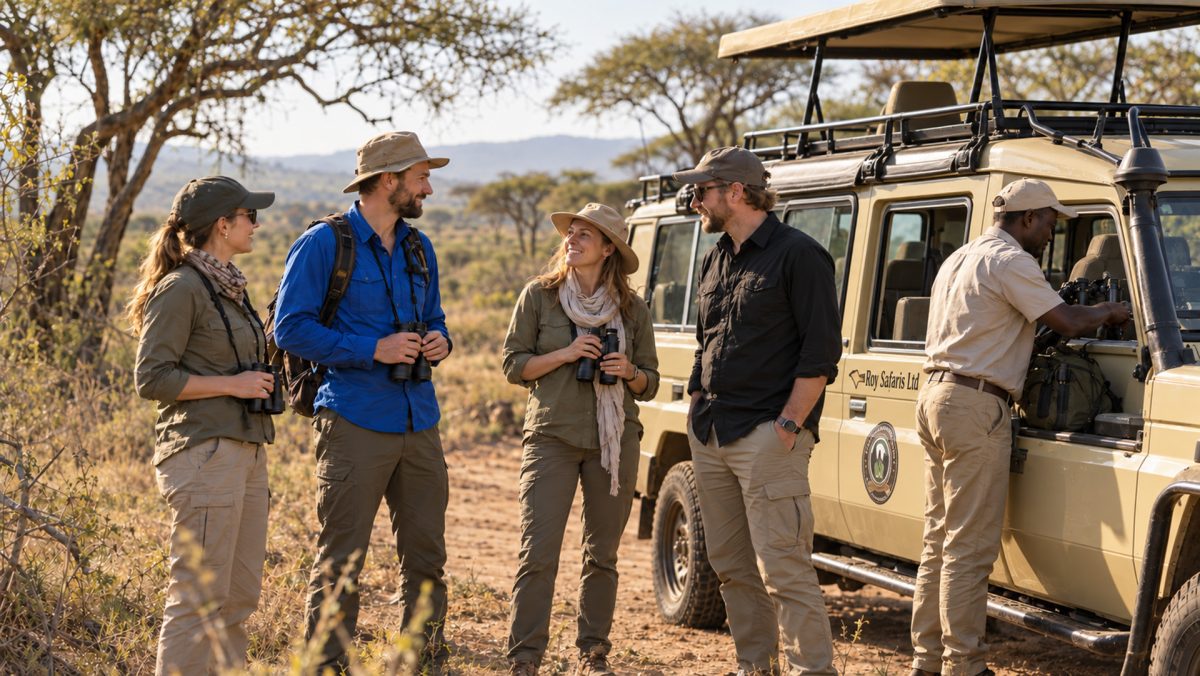
Yes, there is evidence behind the advice. Tsetse flies respond strongly to certain blues, black and high-contrast visual targets. That is why blue and black fabric has been used in traps and insecticide-treated targets across parts of Africa.
But the answer to whether blue and black attract tsetse flies needs more nuance than “never wear blue on safari.” Much of the research involves large pieces of carefully selected fabric designed to attract flies. It does not prove that one navy sock will turn its owner into the most popular person in the Serengeti.
Clothing colour is a sensible precaution, not an invisible shield. Where you travel, the habitat you enter, the local tsetse population, the vehicle and the amount of skin covered can matter just as much.
Why are tsetse traps blue and black?
Tsetse control teams have spent decades studying how the flies respond to coloured surfaces. Their work led to the familiar blue and black traps sometimes seen near wildlife areas, livestock zones and rural communities.
Blue helps draw the flies towards a visual target. Black panels are often used because tsetse show a strong tendency to land on them. The combination allows the trap to attract the insect and then bring it into contact with a treated surface or trapping mechanism.
Even here, “blue” is not one single scientific category. Different materials reflect light differently, and experiments have shown that particular shades and wavelengths can attract more flies than others. Royal blue or phthalogen blue cloth commonly used in control targets is not visually identical to every pale blue, faded denim or blue-grey safari shirt.
Black also creates a strong, dark target. It may resemble the visual contrast associated with a large animal host or a shaded resting place. Tsetse do not identify a black shirt as clothing in the way a person does. They respond to a combination of visual cues, movement, contrast, odour and the surrounding environment.
Does wearing blue guarantee that you will be bitten?
No. A blue or black outfit may be a less sensible choice in a tsetse area, but it does not guarantee a bite. Neutral clothing does not guarantee that you will avoid one either.
The original colour findings largely come from controlled traps and targets. These can be much larger and more visually consistent than a shirt worn inside a moving safari vehicle. A person also produces body heat, breath, movement and odours, while a vehicle creates an even larger moving object.
This means colour should be treated as one manageable part of the risk. If two otherwise suitable shirts are available, choosing khaki instead of vivid blue is reasonable. Buying an entirely new designer safari wardrobe because one pair of trousers is dark navy is usually unnecessary.
When planning a Tanzania safari, it is more useful to understand the environments on the route than to become anxious about one item in the suitcase.
Which colours should you wear on safari?
For game drives, muted earth tones remain the easiest recommendation. Khaki, beige, tan, olive, light brown and muted grey work well in most safari settings. They are practical, do not create strong visual contrast and handle visible dust better than white clothing.
| Colour | Practical safari verdict | What to know |
|---|---|---|
| Khaki, beige and tan | Excellent everyday choices | Neutral, practical and good at hiding dust |
| Olive and muted green | Generally suitable | Choose subdued tones rather than very dark green |
| Muted grey | A useful alternative | Lighter greys are preferable to charcoal |
| Bright or royal blue | Best avoided in known tsetse areas | Some saturated blues are used in tsetse targets |
| Black and very dark navy | Not ideal as the main outer layer | Creates a dark, high-contrast surface and can feel hot |
| White and cream | Acceptable but impractical | Dust becomes visible very quickly |
There is no requirement to dress from head to toe in matching khaki. A muted green shirt, beige trousers and a neutral fleece are perfectly reasonable. Safari clothing should remain comfortable, breathable and suitable for changing temperatures.
Fabric may matter more than travellers expect
Tsetse flies can bite through thin material. A light layer that works well against the sun may offer limited protection against a determined biting fly.
In areas where tsetse are active, medium-weight trousers and a medium-weight long-sleeved shirt provide more physical protection than very thin leggings or loosely woven fabric. Socks help cover the gap between trousers and shoes.
This does not mean wearing thick expedition clothing throughout a hot afternoon. A better approach is to carry an additional long-sleeved layer in the vehicle and put it on if your guide reports increased fly activity.
Clothes should also allow you to cope with cold early starts and warmer afternoons. Our first-time Tanzania safari guide explains why layers are more useful than one heavy outfit.
Where are you more likely to encounter tsetse flies?
Tsetse exposure is not uniform across Tanzania. You can spend days on safari without seeing one, then enter a wooded or riverine section and notice several around the vehicle.
The flies are associated with particular habitats rather than hotel star ratings or safari circuit names. Woodland, bush, river systems and areas supporting suitable wildlife hosts can create more favourable conditions than exposed plains.
Parts of Tarangire National Park can produce tsetse encounters, particularly along certain wooded routes. Experiences may also vary between sections of the Serengeti.
Southern Tanzania contains extensive woodland, rivers and relatively remote wilderness. Travellers visiting Nyerere National Park or Ruaha National Park should therefore include neutral, covering clothing in their packing rather than assuming flies are only a northern circuit issue.
Conditions can change within the same park. One game-drive route may be quiet while another produces several persistent flies. This is why current information from the guide on the ground is more useful than a sweeping statement that an entire park is either “full of tsetse” or “tsetse-free.”
Is there a tsetse fly season in Tanzania?
There is no simple nationwide tsetse season that allows travellers to avoid every encounter by selecting one month.
Fly activity and traveller experiences can be influenced by temperature, vegetation, rainfall, habitat and the local species. Recent conditions may therefore matter more than a generic dry-season or wet-season label.
Reports from travellers can also be misleading. One person may describe a difficult encounter after driving through a particular woodland, while someone visiting the same park in the same month may use a different route and barely notice the flies.
The sensible response is to pack for the possibility throughout the year, particularly when visiting known wildlife and woodland habitats. A neutral long-sleeved layer takes little luggage space and avoids the need to predict conditions months in advance.
Why do tsetse flies follow safari vehicles?
Tsetse flies are often noticed around moving vehicles. The vehicle is a large visual object passing through their habitat, and its movement can provoke an approach.
A fly may enter through an open window or the raised roof and remain inside after the vehicle has moved away from the original area. Travellers can therefore assume that their clothing attracted every fly when the vehicle itself was the more obvious stimulus.
Guides familiar with the route often know the sections where tsetse are regularly encountered. If flies enter the vehicle, follow the guide’s advice and avoid panicked movements. Frantic swatting inside a confined vehicle can be more disruptive than the fly itself, especially when people are holding cameras or standing beneath the open roof.
Before getting back into a stationary vehicle in an affected area, a quick visual check can help. Pay attention around seats, windows and darker interior surfaces.
Does insect repellent stop tsetse bites?
Standard insect repellents are not considered reliably effective against tsetse flies. They should not be treated as the main defence.
That does not make repellent useless on safari. Tanzania has mosquitoes, ticks and other biting insects for which properly selected repellents and treated clothing may still be valuable. Travellers should follow advice from a qualified travel-health professional based on their destination and medical history.
For tsetse, the more practical measures are:
- Wear neutral rather than bright or very dark outer clothing
- Choose long sleeves, trousers and socks
- Use fabric substantial enough to reduce bites through clothing
- Follow the guide’s advice in known tsetse areas
- Inspect the vehicle if flies have been active nearby
- Avoid pushing unnecessarily into dense bushes during stops or walks
Repellent should support a broader insect-bite strategy, not replace suitable clothing.
How dangerous is a tsetse fly bite?
Tsetse bites can be painful. Many safari encounters end with nothing more serious than temporary discomfort, irritation or swelling.
The flies can also transmit human African trypanosomiasis, commonly known as sleeping sickness. The disease is rare among international travellers, but rare does not mean impossible. Not every tsetse fly is infected, and being bitten does not mean that a traveller has contracted the disease.
There is no preventive vaccine or tablet for sleeping sickness. Avoiding bites is therefore the main precaution.
If you develop an unexplained fever, severe headache, unusual tiredness, muscle pain, swollen lymph nodes or a painful red sore after possible tsetse exposure, seek medical care promptly and mention the safari location and the possibility of a tsetse bite. Symptoms should not be self-diagnosed from an online article.
Do you need to leave all blue and black clothes at home?
No. Use proportion rather than panic.
A black outfit for dinner at the lodge is not the same as wearing black throughout a game drive in an area with active tsetse. A pale blue shirt is not necessarily equivalent to the highly attractive blue material selected for a fly-control target. Dark camera bags, shoes and small accessories are difficult to eliminate and should not become a source of anxiety.
Prioritise the clothing that covers the largest visible area of your body during game drives. Shirts, jackets and trousers are more relevant than a watch strap or the trim on a backpack.
If your wardrobe already contains suitable beige, olive, tan or muted grey clothing, pack it. If most of your clothes are blue or black, add two or three neutral outer layers rather than replacing everything you own.
A realistic safari packing combination
For most travellers, a simple rotation is enough:
- Two or three neutral long-sleeved shirts
- Two pairs of khaki, olive, tan or grey trousers
- One warm neutral fleece or jacket
- Comfortable socks that cover the ankles
- Closed walking shoes
- A wide-brimmed hat in a muted colour
- A lighter change of clothing for the lodge
Blue jeans are not forbidden, but they can be hot, heavy and slow to dry. Their colour is only one reason they may be less convenient than lighter safari trousers.
The practical verdict
Blue and black clothing can be more attractive to tsetse flies, and the advice to wear neutral colours has a genuine scientific basis. The exaggeration begins when colour is presented as the only factor determining whether someone gets bitten.
Choose khaki, beige, olive, tan or muted grey when practical. Cover exposed skin in areas where tsetse are active, carry a medium-weight layer and listen to the guide who has driven the route recently.
Then stop worrying about the colour of every sock. A well-planned safari should leave considerably more room in your mind for elephants, lions and landscapes than for one dark T-shirt at the bottom of your bag.
If you would like help choosing parks, seasons and realistic travel routes, explore our Tanzania safari experiences or speak to us about an itinerary suited to the way you want to travel.
This article provides general travel information and is not medical advice. Consult a qualified travel-health professional for recommendations based on your itinerary and personal medical history.