Africa Travel Guide, Where Should You Visit? A Region-by-Region Travel Guide
August 10, 2026
“I want to visit Africa” sounds simple, but it is a bit like saying “I want to visit Earth.” Africa is not one country. It is 54 countries spread across a landmass big enough to fit the United States, China, India, and most of Western Europe inside it, with room left over. A gorilla trek in Rwanda, a desert crossing in Morocco, and a wine tasting outside Cape Town all count as “African travel,” but they have almost nothing in common. Different climate, different culture, different cost, different daily experience.
So before you book anything, the real first question is not “should I go to Africa.” It is “which part.” This guide splits the continent into its five common travel regions: North, West, East, Central, and Southern Africa. For each one, we cover the countries, what the region is known for, and what makes specific countries worth picking over their neighbors.
North Africa: Desert, Ancient History, and the Mediterranean
Countries: Morocco, Egypt, Tunisia, Algeria, Libya
North Africa sits closer to Europe than to the rest of the continent, and it feels that way. The culture is mostly Arab and Berber, Islam is the dominant religion, and the landscape swings between Mediterranean coastline and the open Sahara. This region suits travelers who want ancient civilization, desert scenery, and walkable historic cities more than wildlife.
Morocco is the most visited country here, and it earns that spot. You can walk the medinas of Fez and Marrakech, ride a camel into the Sahara for a night under the stars near Merzouga, and hike the Atlas Mountains, sometimes all in one two-week trip. Egypt is the other big name, and it is built around one thing: history you can actually touch. The Pyramids of Giza, the temples of Luxor, and a Nile cruise between them still make one of the most iconic trips in the world. The Red Sea coast around Hurghada and Sharm El Sheikh also has some genuinely excellent diving. Tunisia is the quieter option, with the ruins of Carthage, whitewashed coastal towns like Sidi Bou Side, and, for film fans, several desert locations used in the original Star Wars films.
Algeria and Libya get far fewer visitors. Visa rules are more complicated, and Libya still has ongoing instability. Most first-time visitors to North Africa choose Morocco or Egypt.
West Africa: Music, History, and Coastline
Countries: Nigeria, Ghana, Senegal, Ivory Coast, The Gambia, Sierra Leone, Liberia, and others along the Gulf of Guinea
West Africa does not get marketed as hard as East or Southern Africa, but it may be the most culturally rich part of the continent. It is the ancestral home of much of the African diaspora in the Americas, and the roots of genres from jazz to Afrobeats trace back here. Trips in this region tend to focus on cities, coastline, and history rather than safari.
Ghana has become the standout destination. Its 2019 “Year of Return” campaign invited the African diaspora to reconnect with their roots, and it turned into a lasting wave of heritage tourism. Cape Coast Castle and Elmina Castle, both former departure points in the slave trade, are heavy but essential stops. Accra itself has grown into a genuinely lively cultural capital too. Senegal offers a similar heritage pull at Gorée Island off the coast of Dakar, plus the strange pink waters of Lake Retba. Nigeria, the region’s largest economy, is less of a conventional tourist stop, but it has become the continent’s cultural export engine. Lagos nightlife and the Afrobeats scene now pull in a growing number of younger travelers just for the music and food. The Gambia, despite being Africa’s smallest mainland country, has built a solid beach and birdwatching industry on its short Atlantic coast, popular with UK travelers thanks to short direct flights.
East Africa: The Classic Safari (and More Than Gorillas)
Countries: Kenya, Tanzania, Uganda, Rwanda, Ethiopia, Burundi
East Africa is what most people picture when they hear “safari,” and the reputation is earned. The common thread across this region is savanna wildlife viewing, generally strong tourism infrastructure, and the option to add a beach stop at the end of a trip. But the countries here have different enough specialties that “just going on safari” undersells how different a Kenya trip is from a Rwanda trip.
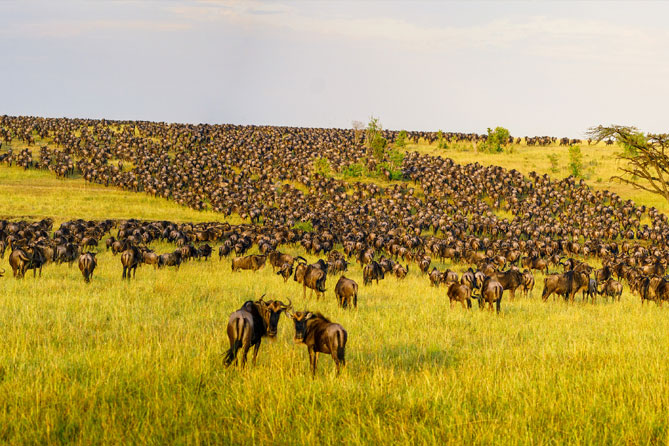
Kenya and Tanzania are the traditional safari heavyweights, and they actually share the same ecosystem. The Serengeti in Tanzania and the Maasai Mara in Kenya are two halves of one continuous landscape, joined by the Great Wildebeest Migration. If seeing the migration’s river crossings is the goal, timing matters more than which country you pick. The herds are generally crossing the Mara River and moving between the northern Serengeti and the Maasai Mara from around July through October. Calving season, on the other hand, happens in the southern Serengeti from January to March. Tanzania also has two things Kenya does not: Mount Kilimanjaro, Africa’s tallest peak and one of the more achievable high altitude climbs in the world for a reasonably fit non-technical trekker, and the Ngorongoro Crater, a self-contained caldera so packed with wildlife people call it Africa’s Eden.
Then there is the one experience neither Kenya nor Tanzania offers: mountain gorilla trekking. This only exists in three places on Earth. Rwanda’s Volcanoes National Park, Uganda’s Bwindi Impenetrable and Mgahinga National Parks, and Congo’s Virunga National Park. If gorillas are the priority, the choice between Rwanda and Uganda usually comes down to budget and terrain. A Rwanda gorilla permit runs around $1,500 per person. Uganda’s equivalent permit is roughly $800, and it can drop to about $600 during the April, May, and November low season. That makes Uganda the cheaper route to the same experience, though Rwanda’s trekking terrain is generally gentler and its lodges tend to be more polished. Both countries only issue a limited number of permits each day, so anyone set on gorilla trekking should book several months ahead, especially for dates between June and September. Uganda also has chimpanzee tracking in Kibale Forest, plus some of the best wilderness whitewater in East Africa along the Nile near Jinja.
Ethiopia stands apart from the rest of East Africa’s safari identity. It is a mountainous, high altitude country with its own ancient Christian history, most famously the rock-hewn churches of Lalibela, carved straight out of solid rock in the 12th century. Add trekking in the dramatic Simien Mountains, and you get a completely different kind of trip, built around history and hiking rather than wildlife.
Related content: East Africa Travel Guide
For beach time, Zanzibar (part of Tanzania) is the region’s most popular add-on. Turquoise water, Stone Town’s old Swahili architecture, and a short flight connection from most safari circuits, which is exactly why it gets tacked onto the end of so many Serengeti trips.
A practical note worth passing on from people who have actually done these trips: it is easy to underestimate how much time it takes to move between parks by road, and easy to overestimate how much you’ll want to pack into two weeks. A common piece of on-the-ground advice is to pick one or two countries per trip rather than trying to string together Kenya, Tanzania, Rwanda, and Uganda in a single two-week run. The flights and border logistics eat more time than people plan for.
If Kenya, Tanzania, Uganda, Rwanda, Burundi, or Zanzibar is on your list, it is worth working with an operator that runs itineraries across the whole cluster instead of piecing together separate bookings country by country. Roy Safaris, based in Tanzania, plans trips across this region as one connected itinerary. A Serengeti safari that flows into gorilla trekking in Rwanda, or a Zanzibar beach extension, can be built as a single trip instead of several disconnected ones.
Central Africa: The Continent’s Least-Touristed Wilderness
Countries: Democratic Republic of Congo (DRC), Republic of Congo, Gabon, Cameroon, Central African Republic
Central Africa is the Congo Basin, the second-largest rainforest on Earth after the Amazon, and it is by far the least visited of Africa’s five regions. Infrastructure is limited and travel takes real effort. This is not a region for a first Africa trip. But for travelers who have already done East and Southern Africa’s safari circuits and want something almost nobody else has seen, it delivers.
Gabon is the region’s most accessible entry point, and it has quietly built a reputation among serious wildlife travelers. Loango National Park is famous for one specific, almost unbelievable sight: forest elephants, and sometimes hippos, wandering straight onto the Atlantic beach. The DRC offers gorilla trekking in Virunga National Park at a fraction of Rwanda’s permit price. It also has Nyiragongo, one of the few volcanoes in the world with a permanently active lava lake you can hike to and camp beside, though the DRC’s security situation varies by region and needs careful, current research before booking. Cameroon, sometimes nicknamed “Africa in miniature” for the range of terrain packed into one country, offers rainforest, savanna, and coastline within a single trip, plus Mount Cameroon, West Africa’s tallest peak, and some of the continent’s most localized biodiversity.
Southern Africa: Big Skies, Self-Drive Safaris, and Polished Infrastructure
Countries: South Africa, Namibia, Botswana, Zimbabwe, Zambia, Mozambique
Southern Africa is where safari meets serious infrastructure. Roads are generally better, self-driving is far more common and often encouraged, and the region suits travelers who want more independence and a wider range of experiences than wildlife alone. Wine country, dramatic desert scenery, and world-class waterfalls all sit within a few hours of each other in places.
South Africa is the region’s most complete single-country trip. Cape Town covers coastline, mountains (Table Mountain), and the Cape Winelands within a short drive. Kruger National Park delivers reliable Big Five sightings and is one of the few major parks in Africa set up for confident self-drive safaris, so you do not always need a guided vehicle. Namibia is built around landscape rather than wildlife density: the towering red dunes of Sossusvlei, the eerily beautiful Skeleton Coast, and some of the darkest night skies left on Earth for stargazing. Botswana takes the opposite approach from South Africa. It deliberately limits visitor numbers to keep the experience exclusive and undisturbed. The Okavango Delta, a rare inland river delta that floods seasonally and turns into a maze of channels and islands, is best explored slowly by mokoro (a traditional canoe) with small guided camps rather than big lodges. Zimbabwe and Zambia share Victoria Falls between them, one of the largest waterfalls in the world by combined width and height. Each side offers a different view and different activities, and bungee jumping and white water rafting are mostly concentrated on the Zambian side. Mozambique adds the beach half of the equation, with the Bazaruto and Quirimbas Archipelagos offering some of the least developed diving and snorkeling coastline on the continent.
So, How Do You Actually Choose?
Strip away all the regional detail, and the decision usually comes down to four questions.
- What do you actually want to do? Wildlife points you toward East or Southern Africa. History and desert scenery point to North Africa. Culture, music, and heritage tourism point to West Africa. True off-the-beaten-path wilderness points to Central Africa.
- How much time do you have? A week or less favors a single-country trip, like Kenya, South Africa, or Morocco alone. Two weeks or more opens up realistic multi-country combinations, especially within East or Southern Africa.
- What is your budget? Rwanda and Botswana price themselves as premium, low-volume experiences. Uganda, South Africa, and Kenya offer more flexibility for similar experiences at a lower cost.
- Is this your first Africa trip, or a repeat visit? First-timers are usually best served by East or Southern Africa, where infrastructure is strongest and logistics are simplest. Central Africa and parts of West Africa reward people who already know roughly what they are doing.
There is no single “best” region. There is only the one that matches what you actually want out of the trip. Once you have narrowed it down to a region, and ideally one or two countries within it, the rest of the planning gets a lot easier.