Where Is Mount Kilimanjaro? Location, Map and How to Get There
November 7, 2026
Mount Kilimanjaro is in north-eastern Tanzania, in East Africa, just south of the border with Kenya. It stands about 330 km south of the equator, inside Kilimanjaro National Park in the Kilimanjaro Region. The nearest towns are Moshi, at its southern foot, and Arusha, about 80 km to the west.
That is the short answer. The longer answer matters if you are planning a trip, because where Kilimanjaro sits on the map decides where you fly into, where you sleep the night before a climb, and where you can see it without climbing at all.
Mount Kilimanjaro location at a glance
| Question | Answer |
|---|---|
| Country | Tanzania |
| Region | Kilimanjaro Region (Moshi Rural, Hai, Siha and Rombo districts) |
| Continent | Africa (East Africa) |
| Coordinates | About 3°04′ S, 37°21′ E |
| Height | 5,895 m at Uhuru Peak |
| Protected area | Kilimanjaro National Park, 1,688 km², UNESCO World Heritage Site since 1987 |
| Nearest airport | Kilimanjaro International Airport (JRO) |
| Nearest town | Moshi |
| Neighbouring country | Kenya, whose border runs along the mountain’s northern side |
Kilima>Kilimanjaro’s neighbours on the map
manjaro does not stand alone in a blank space. Around it lies some of the best-known country in East Africa.- Mount Meru: about 70 km to the west, inside Arusha National Park. At around 4,566 m it is Tanzania’s second-highest mountain and a popular warm-up climb.
- Arusha National Park: between Arusha and Moshi, with forest, lakes and giraffe, and views of both mountains on clear days.
- Amboseli National Park (Kenya): just across the border to the north, famous for its elephants and its view of the mountain.
- Tsavo West National Park (Kenya): to the north-east, with lava flows and springs.
- The West Kilimanjaro plains: open Maasai country between Kilimanjaro and Meru, where wildlife moves between Tanzania and Kenya.
Why th>Why the two sides of the mountain feel so different
t winds from the Indian Ocean hit Kilimanjaro’s southern and eastern slopes first, so those sides get the most rain. That is why Moshi, Marangu and Machame sit among banana groves, coffee farms and thick forest, home to the Chagga people. The northern side lies in the mountain’s rain shadow and is much drier, with fewer trees. This difference is practical, not just scenic: in the rainy months, a climb from the north is usually drier underfoot.Is Kil>Is Kilimanjaro in Kenya or Tanzania?
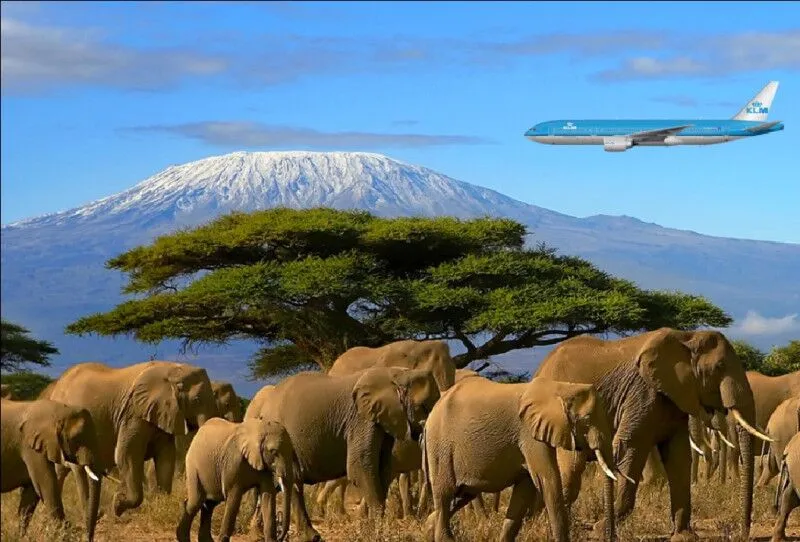
manjaro is entirely in Tanzania. The confusion is understandable. Many of the most famous photographs of the mountain are taken from Amboseli National Park in Kenya, with elephants in the foreground and the snowy summit behind them. The view is Kenyan. The mountain is not.The border between the two countries was drawn in the colonial era and passes just north of the mountain. Every climbing route, every park gate and the summit itself are on the Tanzanian side. If you want to climb, you fly into Tanzania.
Where >Where Kilimanjaro sits on the map of Africa
ure the east coast of Africa. Find Kenya and Tanzania, which share a long border running inland from the Indian Ocean. Follow that border north-west from the coast for about 250 km. Kilimanjaro rises just below it, on the Tanzanian side, between the coastal port of Tanga and the safari town of Arusha.It is close enough to the equator to have about twelve hours of daylight all year, yet high enough to carry glaciers on its summit. On very clear days, the snow cap can even be seen from Nairobi, Kenya’s capital, around 225 km away.
Distan>Distances from key places
Drive times are typical and change with traffic, roadworks and rain.
The mo>The mountain’s layout: three volcanoes, one massif
manjaro is not a single peak. It is a huge volcanic massif made of three cones. Shira, the oldest, is in the west and has collapsed into a high plateau. Mawenzi, in the east, is jagged and rocky. Kibo, in the middle, is the youngest and highest, and its crater rim holds Uhuru Peak, the summit. Our guide to Kilimanjaro National Park covers the park itself in more detail.Where >Where the climbing routes start
p of the routes makes the mountain much easier to understand. Most routes begin on the wetter southern and western slopes, close to Moshi:- Marangu Gate (south-east): Marangu route, and the park headquarters.
- Machame Gate (south): Machame route.
- Umbwe Gate (south): the steep Umbwe route.
- Londorossi Gate (west): Lemosho and Shira routes, and the Northern Circuit.
- Rongai Gate at Nalemoru (north, near the Kenyan border): Rongai route.
- Mweka Gate (south): the descent route used by most climbs.
Rongai is the only route that starts on the northern side. That side is in the mountain’s rain shadow, so it is drier, which is why we often suggest it for climbs in the wetter months. Roy Safaris runs the 7-day Rongai route climb and the 6-day Marangu route climb.
How to>How to get to Kilimanjaro
st everyone flies into Kilimanjaro International Airport (JRO), which sits between Moshi and Arusha. Some international airlines fly there directly. Others connect through Nairobi, Addis Ababa, Doha, Dubai or Amsterdam.From the airport, most climbers spend one night in Moshi or Arusha before the climb. That night does three useful jobs. It gives you time to recover from the flight. It lets your operator check your gear the evening before. And it means that if a bag is delayed, there is still a day to recover it before you need it on the mountain.
Moshi is the closer base for most gates. Arusha has more hotels and is the better base if you are joining a safari afterwards. Our list of the best hotels in Arusha includes options that work before or after a climb.
Where >Where you can see Kilimanjaro without climbing it
mountain is often hidden in cloud, especially in the middle of the day and during the rains. The best chances of a clear view are early morning and late afternoon, in the drier months.- From the plane: on clear days, flights into JRO can pass close enough for a superb view. Ask for a window seat.
- From Moshi: the summit appears above the town on many clear mornings.
- From Amboseli National Park in Kenya: the classic view, if you are combining Kenya and Tanzania.
- From Arusha National Park: on clear days, you can see Kilimanjaro across the plains, with Mount Meru much closer.
- On a day hike: you can walk part of the lower Marangu route through the rainforest without climbing the whole mountain.
Why Ki>Why Kilimanjaro’s location makes it unusual
position, so close to the equator and rising alone from the plains, is what makes Kilimanjaro special. It is often called the world’s highest free-standing mountain because it is not part of a range. In a single climb you pass from farmland and rainforest through moorland and alpine desert to a summit with glaciers, all within a few days’ walk.That same location is why its ice is shrinking. Studies estimate that the mountain has lost more than 80% of the ice cover first mapped in 1912.
Quick >Quick answers
ch country is Mount Kilimanjaro in?Tanzania. It is in the Kilimanjaro Region in the north-east of the country, near the Kenyan border.
Is Mou>Is Mount Kilimanjaro in Africa?
It is in East Africa and is the highest mountain on the African continent.What i>What is the closest city to Kilimanjaro?
i, at the foot of the mountain. Arusha is the larger city nearby, about 80 km west of Moshi.Can yo>Can you see Kilimanjaro from Kenya?
especially from Amboseli National Park. But you cannot climb it from Kenya.Once you know where the mountain is, the next question is how to climb it. Start with our complete guide to climbing Kilimanjaro, or ask us to plan your climb and the safari that follows.