Tanzania’s October El Niño Update: What Was Forecast and What Has Happened So Far
October 22, 2026
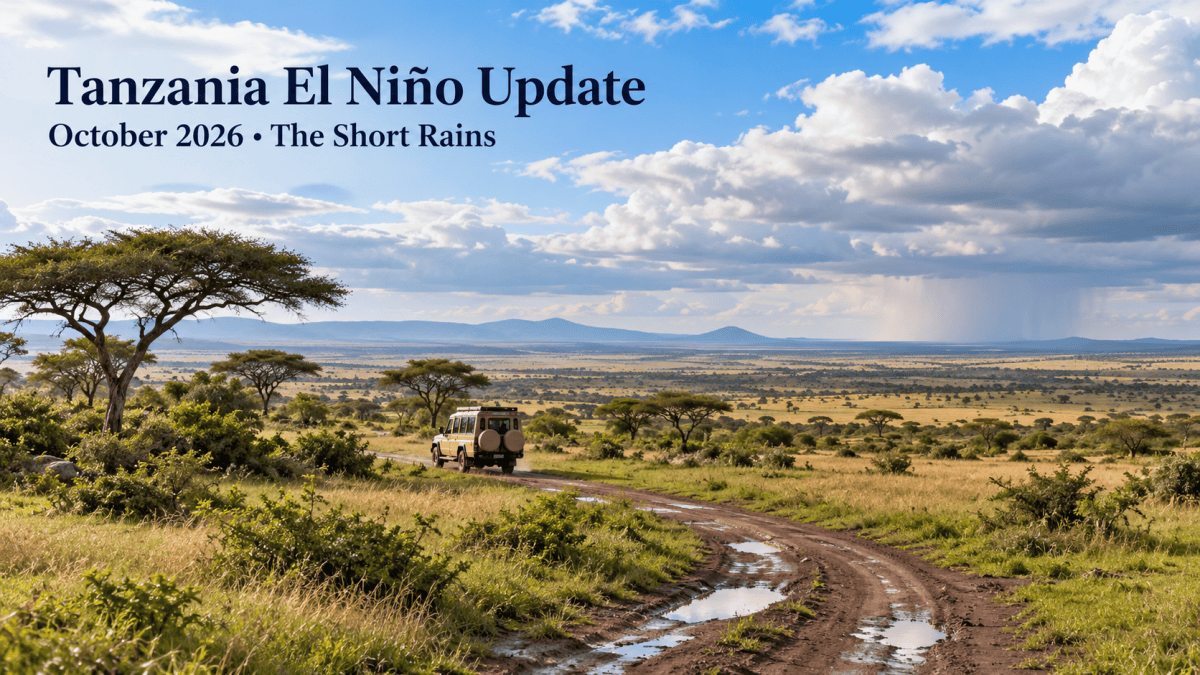
Updated: 21 October 2026. Recorded rainfall discussed below covers 1–10 October, the latest observation period we could verify for this update.
El Niño warnings can leave travellers imagining the same scene across Tanzania: dark skies, flooded roads and holidays spent indoors. The recorded early-October picture is more varied than that.
This Tanzania El Niño update compares the seasonal outlook with rainfall recorded so far. Rain has fallen in parts of the country, but the available observations do not show uniformly wet conditions. Just as importantly, October marks the start of the usual short-rains season in northern and coastal Tanzania. Not every shower is an exceptional El Niño event.
What was forecast for October?
The Tanzania Meteorological Authority’s outlook for October–December anticipated average to above-average rainfall across much of the northern coast, northeastern highlands, Lake Victoria zone and northern Kigoma.
Rain was expected to spread during October, with a more pronounced increase in November. The outlook also allowed for rainfall continuing into January 2027.
This was a seasonal warning about increased rainfall and associated risks, not a prediction that every destination would receive heavy rain from the beginning of October.
What has actually happened?
ICPAC’s observed climate assessment for 1–10 October shows contrasting conditions across Tanzania.
Some areas received between 26 and 100 millimetres over those ten days. Other areas received 6–25 millimetres, while several parts recorded just 0–5 millimetres. Some locations recorded no rainfall.
The comparison with normal conditions is equally useful: parts of Tanzania were near normal, while other areas were drier or much drier than normal.
So, yes, rain has arrived in some places. But the early observations do not support a description of persistent, exceptionally heavy rain throughout the country. They also cannot establish conditions at every Serengeti camp, Ngorongoro lodge or Zanzibar beach.
A more measured start does not invalidate the outlook
The opening ten days were not uniformly wet. That is a useful reassurance, but it is not evidence that the seasonal forecast was wrong.
A three-month outlook and a ten-day rainfall assessment answer different questions. A season can begin unevenly and become wetter later. TMA had already highlighted November as a period when rainfall could increase.
The fair comparison is therefore this: the outlook raised the possibility of a wetter season, while the verified early-October observations show a mixed start. It is too soon to judge October as a whole.
Remember, these are the short rains
Northern and coastal Tanzania normally experience two rainy seasons. The short rains, called Vuli, generally occur from October to December. The long rains, known as Masika, usually fall from March to May.
These should not be confused. October rainfall is part of the normal seasonal calendar, even without El Niño. The question this year is whether rainfall becomes unusually plentiful, persistent or disruptive compared with what is typical.
“Short rains” describes the season, not a guarantee that every shower will be brief or light. Equally, rain appearing in an October forecast does not mean an entire holiday will be wet.
What does this mean for your safari?
For anyone with a trip booked, local information is more useful than a countrywide headline. Ask your operator about the roads serving your actual accommodation and the latest guidance from park authorities.
On a Serengeti safari, the important question is not simply whether it has rained, but whether your access roads and planned game-drive areas remain suitable.
We recommend a well-maintained four-wheel-drive vehicle, sensible transfer times and flexibility within your safari itinerary. A guide should change course when necessary, never attempt an unsafe water crossing to preserve a schedule.
For Zanzibar, check marine forecasts separately before boat trips. Mainland rainfall does not establish conditions around Unguja or Pemba.
Where October stands
The observations available so far give a more nuanced picture than blanket descriptions of extreme weather: rain in some areas, little in others, and considerable variation.
Keep the seasonal outlook in mind, but make travel decisions using current local warnings and confirmed route conditions. This remains an October update, not a verdict on the months ahead. November and December will have their own assessments when there is recorded weather to compare.
Sources: ICPAC observed climate monitoring; TMA’s 2026 Vuli seasonal advisory.