El Niño in Kenya: What October Brought, and What It Means for November and December
October 24, 2026
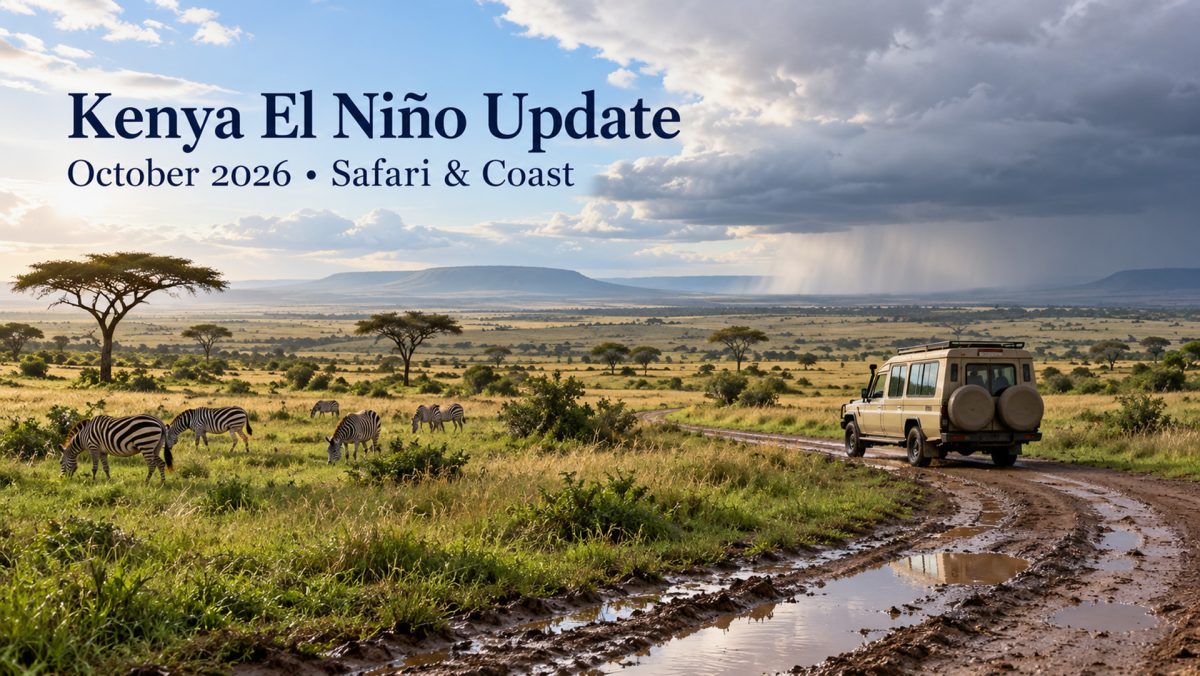
In August, Kenya’s forecasters warned that a strong El Niño would bring a wetter than normal short rains season. Three weeks into October, the rains have started, but unevenly. Some inland stations have recorded very heavy falls, while rainfall decreased in several coastal counties and in Nairobi in mid-October.
This El Niño update for Kenya compares the forecasts with the weather bulletins so far, for travellers heading on safari or to the coast in November and December.
Last reviewed: 21 October 2026. Rainfall figures are from the Kenya Meteorological Department unless stated otherwise.
A>A normal season, with an El Niño on top
October to December is Kenya’s normal short rains season. El Niño does not create this season. It is one of several climate drivers, along with the Indian Ocean Dipole, that can make it wetter than usual.
El Niño conditions were confirmed in June. In its 8 October update, the US Climate Prediction Center gave a better than 83% chance of strong to very strong El Niño conditions lasting through January to March 2027. That figure describes the event in the Pacific Ocean, not the chance of flooding in Kenya.
What >What was forecast
he Kenya Meteorological Department’s seasonal outlook for October to December, issued in August, forecast above average rainfall over about 80% of the country. It expected the rains to start:- in western Kenya and Narok from September
- in Nairobi and on the coast in the second or third week of October
- in Kajiado, which includes Amboseli, and Taita Taveta, which includes much of Tsavo, in the third or fourth week of October
Its monthly forecast for October updated some of those windows. It said the coastal rains and the rains in Narok were continuing from September, and moved the expected start in Kajiado and Taita Taveta forward to the second or third week of October.
The outlook also forecast prolonged wet spells and occasional isolated storms. Separately, August reporting on the National Disaster Operations Centre’s El Niño briefing listed Narok among the areas of flood concern, and the Nairobi to Narok road among the key transport corridors at risk of flooding.
What t>What the bulletins show so far
e>The co>The coast
September, Mombasa, Mtwapa, Msabaha, Malindi and Lamu all received more rain than their long-term September average. The heaviest single day was 77.1mm at Mtwapa on 11 September.Reporting on 5 October said the Met Department had confirmed that rain had started in parts of 24 counties, including Mombasa, Kwale, Kilifi, Lamu and the Tana Delta. The Met Department counts the rains as having started in an area once it receives a total of at least 20mm over three consecutive days, with no dry spell of more than seven days afterwards.
In the week of 12 to 18 October, rainfall decreased in Mombasa, Kilifi and Lamu compared with the week before. The forecast for 20 to 26 October is for morning, afternoon and night showers in parts of the coastal counties.
Narok >Narok and the Maasai Mara
e Met Department’s agricultural bulletin for 21 to 30 September noted that some areas, such as Narok, recorded no rainfall. By 5 October, Narok was among the counties where rain was reported to have started, and the review of 12 to 18 October said rainfall in Narok increased compared with the week before.The forecast for 20 to 26 October is for sunny mornings with afternoon showers and thunderstorms in parts of the county. It covers Narok County as a whole, not individual camps in the reserve.
Nairob>Nairobi
e bulletins reviewed do not establish a confirmed onset date for Nairobi. Rainfall decreased during 12 to 18 October compared with the preceding week. The weekly reviews do not state Nairobi’s rainfall totals. The forecast for 20 to 26 October is for rain and showers in parts of the county.Where >Where the heaviest rain has fallen
e highest totals in the Met Department’s weekly reviews have all been recorded inland:- 28 September to 4 October: 55.3mm over the week at Kisii
- 5 to 11 October: 207.6mm over the week at Karatina University in Nyeri County, and 133.3mm in a single day at Marsabit on 10 October
- 12 to 18 October: 147.0mm over the week at ADC Sabwani in Trans Nzoia, including 110.0mm on 12 October
Taken together, the weekly reviews show uneven rainfall, with particularly high totals at some inland stations and decreasing rainfall in several coastal counties during 12 to 18 October. Early, uneven rain does not yet show how the full season will compare with the forecast.
What N>What November and December normally look like
e figures below are 1991 to 2020 averages for Jomo Kenyatta International Airport in Nairobi and Moi International Airport in Mombasa. A rainy day is one with at least 1.0mm of rain.| Month | Nairobi rainfall | Nairobi rainy days | Mombasa rainfall | Mombasa average high |
|---|---|---|---|---|
| October | 50.0mm | 6.4 | 103.4mm | 30.0°C |
| November | 130.6mm | 13.8 | 104.7mm | 30.9°C |
| December | 85.4mm | 7.3 | 75.8mm | 32.3°C |
| January | 57.8mm | 4.4 | 33.9mm | 32.8°C |
In a typical year, rain in Nairobi peaks in November and roughly halves in December. In Mombasa, October and November are similarly wet, December is hotter and drier, and January is drier still. The Met Department’s outlook expects the rains in Mombasa, Kwale, Kilifi and Lamu to end in the first or second week of December.
Why this y>Why this year may not be typical
st strong El Niño shows why forecasters are cautious. In 2023, heavy rain began in November. In early December 2023, President William Ruto said 38 of Kenya’s 47 counties had been affected. By 20 December, the UN reported at least 174 deaths since October, with about 90% of affected people living in Mandera, Garissa, Tana River, Wajir, Isiolo and Meru.That does not mean 2026 will repeat 2023, but it is why November is the month to watch.
How Kenya i>How Kenya is preparing
st, the National Disaster Operations Centre said boats would be positioned on major water bodies, with the Kenya Coast Guard and the Navy involved, to keep transport running.In Narok, disaster teams have been repairing two check dams near Narok town and clearing blocked drains. Lodges and camps along the Talek and Mara rivers have been urged to move facilities and equipment away from the riverbanks.
What this m>What this means for your trip
mber safariIn Nairobi, November is normally the wettest month of the short rains, and this year’s outlook is for above average rainfall. The road route from Nairobi to the Maasai Mara follows the A104 and then the B3 to Narok, before continuing to the reserve’s gates, and takes around 5.5 to 6.5 hours depending on the gate. The Nairobi to Narok road has been named among the transport corridors at risk of flooding this season, and floods have damaged the Narok to Mai Mahiu section in past years. Scheduled flights from Wilson Airport reach the Mara’s airstrips in about an hour.
If your trip includes the drive, we recommend considering a flight instead, or keeping the day of the drive free of other plans. Our Kenya safari tours can be arranged either way.
A December >A December safari
pical year, December is drier than November in Nairobi. But the outlook expects rain in Nairobi and Narok to continue into January, so we recommend one spare day before your international flight home.The coast o>The coast over the holidays
stal rains are forecast to end in the first or second week of December. In a typical year, December in Mombasa is hotter and drier than November, with an average high of 32.3°C. If you are planning a beach stay over Christmas and New Year, we recommend checking the Met Department’s weekly forecast in early December.Temperatures>Temperatures
o 26 October, the Met Department forecast lows of 10°C in Narok town and 12°C in Nairobi, and below 10°C in parts of Kajiado, the county that includes Amboseli. These are town and county forecasts, but they are a good reason to pack a warm layer for early morning game drives.Before you trav>Before you travel
="https://meteo.go.ke/our-products/7-days-forecast/" target="_blank" rel="noopener">Kenya Meteorological Department publishes a seven-day forecast every week, with a review of the week before.If you have dates booked for November or December, send us your itinerary. We will look at which legs are most exposed to the rains and whether a flight, a spare day or a change of order would make the trip easier.